The International Consortium of Investigative Journalists (ICIJ) has today published a set of reports based on 715,000 leaked documents about Angola, and particularly Isabel dos Santos, the daughter of former President José Eduardo dos Santos.
In summary, dos Santos enjoyed tremendous Angolan state largesse to amass a large fortune overseas, using more than 400 shell companies and other structures — 94 in recognised tax havens — to park or hide assets. The story once again highlights a menagerie of ‘enablers’ such as the Big Four accounting firm PwC, and Boston Consulting Group, to help her. Dos Santos has denied looting the country.
Newspapers around the world have picked up the story, and we won’t add to the details at this stage. However, we will provide two important bits of context, which will almost certainly have been missed.
First, here’s an excerpt from an IMF report in 1997 (not long after your humble TJN correspondent had served as Reuters‘ and the Financial Times‘ resident reporter in war-ravaged Angola.)
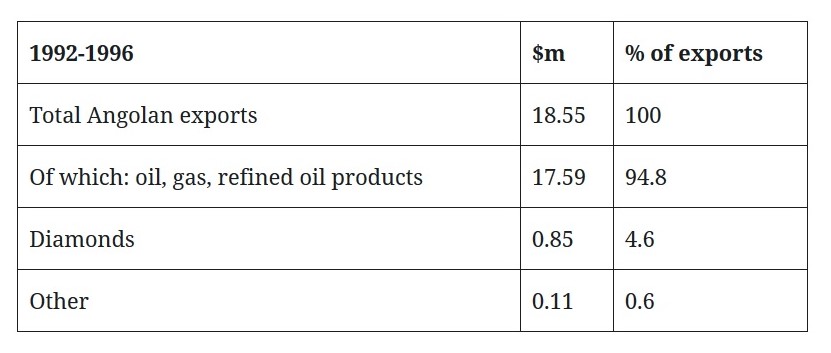
In other words, minerals accounted for 99.4 percent of Angolan exports! One might be tempted to excuse that shocking, astonishing figure, given that Angola had been in the throes of a large-scale civil war since independence in 1975.
One also might have expected this to have improved significantly today. The war ended decisively with the killing of rebel leader Jonas Savimbi in 2002, and Angola has undergone a massive oil-fueled (and Chinese-enhanced) reconstruction effort. Has this helped Angola diversify its economy?
Well, look at the recent data.
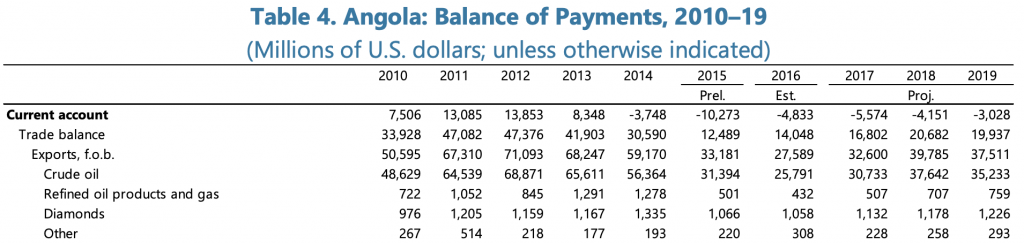
That is, of a (nominal) $487 billion in estimated exports from 2010-2019, just $2.7 billion did not come from petroleum or diamonds. In other words, 99.4 percent of Angola’s exports come from its minerals.
The end of the war and reconstruction does not seem to have dented Angola’s capacity to build a diverse economy. Angola provides a stark illustration of the infamous Resource Curse, a.k.a. the paradox of poverty amidst plenty.
This failure has many causes, but there can be no doubt that kleptocracy – and by extension the enabling role of western (and other) banks, law and accounting firms, real estate agents, tax havens and many others – carry a large share of the blame.
Two more things.
First, it has become increasingly clear – from this set of stories, and from others – that we need to turn our attentions increasingly to Dubai as a paradise for the world’s ne’er do wells. Our imminent Financial Secrecy Index will provide more details.
Second, if western countries are going to crack down on these activities, given the scale and power of the vested interests that enable this stuff, it will never be possible to crack down effectively based on altruistic ideas about helping poor people in countries like Angola. A far more powerful approach comes through understanding the Finance Curse. For more on that, read this recent Guardian article, or this longer piece for the IMF, both by today’s TJN blogger. And there’s more on the “blowback” into western democracies receiving this dirty money, in this TV debate.
The author

Related articles
UN tax convention hub – updates & resources
Launching a new tool to reveal the global extent of illicit financial flows and how to tackle them
UN Framework Convention – Roundup of the Fifth Session of Negotiations
Notes on the UN tax convention draft protocol on dispute prevention and resolution
11 September 2026

The European Court of Justice strikes against transparency again. Our response should be to call for an end to corporate limited liability
Report of the Fifth Session of negotiations on the UN tax convention
4 September 2026
Submission to Workstream I on Co-Lead’s Zero Draft of UN Framework Convention on International Tax Cooperation (post-Fifth Session)
28 August 2026
Submission to Workstream II on Taxation of Income from Cross-Border Services (post-Fifth Session)
26 August 2026
Strengthening public resource mobilization through tax justice
25 August 2026
Submission to Workstream III on Dispute Prevention and Resolution (post-Fifth Session)
24 August 2026